Read newborn blood gases with confidence
NewIQ™ is built for the bedside: enter the values and get age-specific reference ranges, a plain-language interpretation, and the reasoning behind it in seconds.


A reference and education tool for trained clinicians. NewIQ™ does not store patient data and does not replace clinical judgment or institutional protocols.
How it works
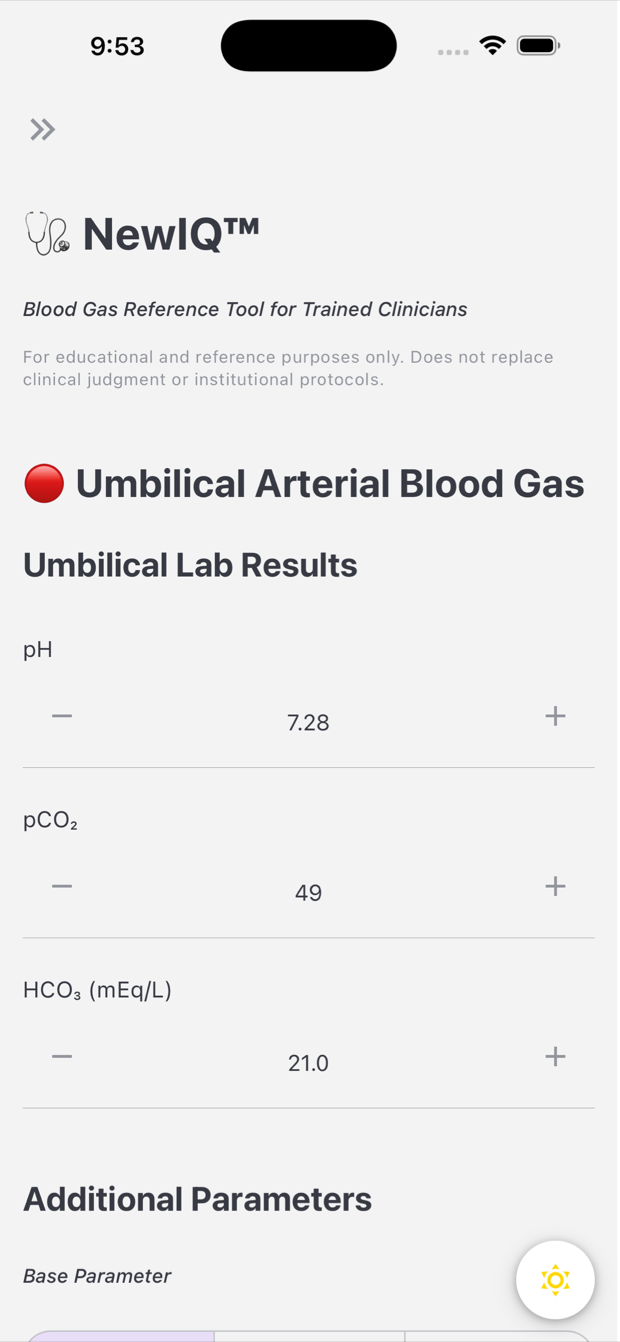
You have the blood gas lab results in your hand. Four taps later you know what they mean, and why.
Pick the sample, enter the values
Umbilical arterial, arterial and other neonatal sample types. Enter pH, pCO₂ and HCO₃ as you have them.
Add what you have, skip what you don't
Base excess or deficit, pO₂, O₂ saturation. Every field has a tap-for-context marker. Then analyze.
See every parameter flagged
Each value marked against its neonatal range, followed by a plain-language acid–base interpretation.
Check the ranges, keep the context
The reference table stays on screen next to monitoring and follow-up considerations, with your unit's policy first.

Why NewIQ™?

Neonatal from the ground up
Not an adult tool with a new label. The ranges, sample types and interpretations were built for newborns.

Fast at the bedside
No login, no setup, no scrolling a binder. Enter the values, get the interpretation, keep moving.

Teaches while it interprets
Reasoning sits next to every result, so a nurse learning gases builds understanding instead of just copying an answer.

No patient data stored
Nothing is saved, synced or sent anywhere. The values live only on the screen in front of you.
Key features
- 01
Neonatal blood gas reference ranges
Organized by sample type and age of life, on screen while you read the result.
- 02
Interpretation guidance
Acid–base status and primary disorder stated in plain language, parameter by parameter.
- 03
Multiple neonatal sample types
Including umbilical cord gases: the newborn's oxygenation status at delivery.
- 04
Educational support
Every parameter carries a tap-for-context marker, for orientation, precepting and study.
- 05
Fast point-of-care access
Designed for one hand, one minute, and the pocket of a scrub top.

Who it's for
Made for the people who read gases at 3 a.m.
Labor & Delivery nurses
NICU nurses
Neonatal nurse practitioners
Physicians
Neonatal transport teams
Students and trainees in neonatal, obstetric, nursing, respiratory therapy and advanced practice programs
What the interpretations mean
The acid–base disorders NewIQ™ reports, with the numbers behind each one and the causes seen most often in newborns.
| Analyte | Symbol | Reference interval | Unit | SI equivalent | SI unit |
|---|---|---|---|---|---|
| Hydrogen ion activity | pH | 7.35 – 7.45 | 35 – 45a | nmol/L | |
| Carbon dioxide tension | PaCO₂ | 35 – 45 | mmHg | 4.7 – 6.0b | kPa |
| Bicarbonate | HCO₃⁻ | 22 – 26 | mEq/L | 22 – 26c | mmol/L |
aExpressed as [H⁺] = 10⁽⁹⁻ᵖᴴ⁾ nmol/L; the interval inverts.
b1 mmHg = 0.1333 kPa.
cBicarbonate is monovalent, so 1 mEq/L = 1 mmol/L.
Respiratory acidosis
An acid–base disturbance caused by inadequate elimination of carbon dioxide (CO₂) by the lungs, leading to CO₂ retention and a drop in blood pH.
Metabolic alkalosis
An acid–base disturbance caused by a gain of bicarbonate (HCO₃⁻) or a loss of acid from the body, leading to a rise in blood pH that does not originate from the lungs.
Respiratory alkalosis
An acid–base disturbance caused by excessive elimination of carbon dioxide (CO₂) through hyperventilation, leading to a rise in blood pH.
Mixed (combined) acidosis
A combined respiratory and metabolic acidosis occurring at the same time: both the lungs' CO₂ elimination and the body's metabolic acid–base balance are impaired simultaneously. This produces a more severe drop in pH than either disorder alone, since neither system can compensate for the other.
Metabolic acidosis
An acid–base disturbance caused by a gain of acid or a loss of bicarbonate (HCO₃⁻) in the body, leading to a drop in blood pH that does not originate from the lungs.
Mixed (combined) alkalosis
Far less common than mixed acidosis in the neonatal population. A combined respiratory and metabolic alkalosis happens when CO₂ elimination is excessive and the body is simultaneously gaining bicarbonate or losing acid, producing a more pronounced rise in pH.
For use by trained clinicians as an educational reference only. This content does not replace clinical judgment, institutional protocols, or the guidance of a supervising physician.
Questions clinicians ask
What NewIQ covers, which samples it reads, what happens to the values you type, and what it deliberately does not do.
How does NewIQ interpret a neonatal blood gas?
Enter the values you have (pH, pCO₂, pO₂, HCO₃, base excess or deficit and O₂ saturation) and NewIQ flags each one against neonatal reference ranges for that sample type and age of life. It then states the acid–base status and the primary disorder in plain language, with the compensatory response and the reasoning shown next to the result rather than hidden behind it.
Which blood gas sample types does NewIQ cover?
Arterial, venous and capillary neonatal samples, including umbilical arterial and umbilical venous cord gases, across term and preterm age windows. The reference ranges change with the sample type and the age of life, and NewIQ picks the right set for you instead of leaving you to remember which column applies.
Can I use NewIQ for umbilical cord gases at delivery?
Yes. Umbilical arterial and umbilical venous samples are first-class sample types in NewIQ, so the newborn's oxygenation and acid–base status at delivery is read against cord gas ranges rather than adult ones.
Is there a blood gas app made for NICU and Labor & Delivery nurses?
That is exactly what NewIQ is. It was built by a Labor & Delivery nurse for the people who read neonatal gases at the bedside: NICU and L&D nurses, neonatal nurse practitioners, physicians, respiratory therapists and neonatal transport teams. There is no login and no setup: it is designed for one hand, one minute and the pocket of a scrub top.
Can students and new nurses use NewIQ to learn blood gas interpretation?
Yes, and that is a large part of why it exists. Every parameter carries a tap-for-context marker explaining what the value means and why it moves, so someone learning gases builds understanding instead of copying an answer. It is used for orientation, precepting and study in nursing, respiratory therapy, medical and advanced practice programs.
Does NewIQ store or transmit patient data?
No. NewIQ is session-only: the values you enter live on the screen in front of you and are not saved, synced or sent anywhere. There is no account, nothing to sign in to and no record left behind when you close the app.
Is NewIQ free?
NewIQ is a paid app: a single purchase on the App Store or Google Play, with no subscription and no account to create. Current pricing is shown on each store listing.
Which devices does NewIQ run on?
iPhone and iPad running iOS or iPadOS 15.1 or later, and Android phones and tablets through Google Play.
Does NewIQ replace clinical judgment or my unit's protocol?
No. NewIQ is a reference and education tool for trained clinicians. It does not diagnose or treat, and it does not replace clinical judgment, a supervising physician, or your institution's protocols, which always come first.

Sabrina Sabri, BSN, RNC-OB
Founder, NewIQ™ · Sabrina Delivers Joy, LLC
Sabrina has spent nearly 30 years at the bedside in Labor & Delivery. She built NewIQ™ because neonatal blood gases deserve a neonatal reference, one a nurse can reach for in the moment it matters.
Follow Sabrina
Tips from the bedside, teaching moments and the story behind NewIQ™: come say hi wherever you like to scroll.



Get NewIQ™ on your phone or tablet
Download today. Ready before your next shift.
No login
No patient data stored
iPhone, iPad & Android

Questions, feedback or hospital enquiries. sabrinadeliversjoy@gmail.com